

What specific effects do different speed settings on leg muscle strength growth at a gym treadmill?
Release Time : 2026-03-02
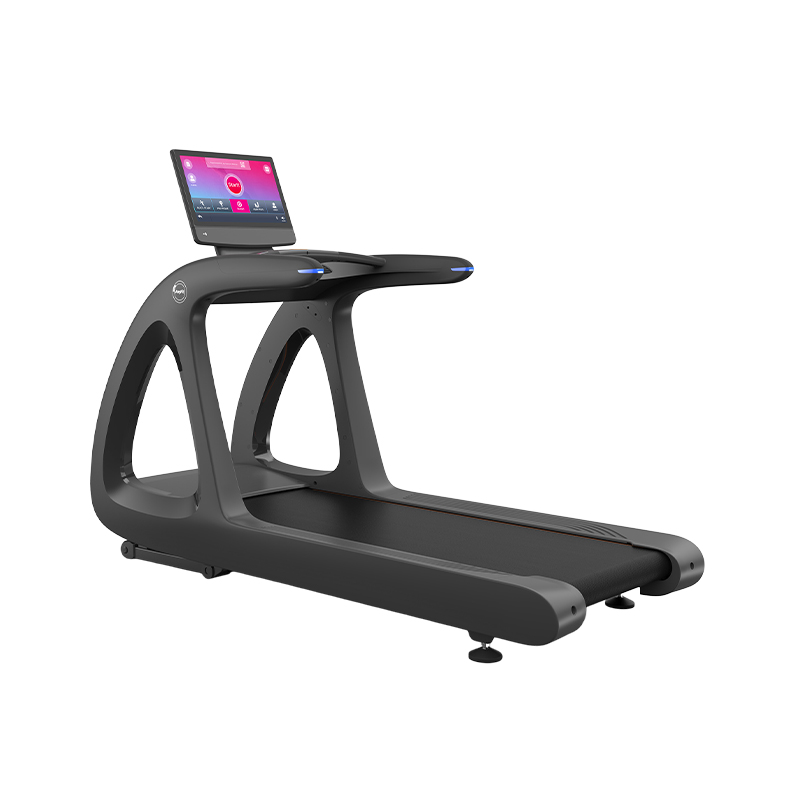
In gym treadmill use, speed setting is a key factor influencing leg muscle strength growth. Different speed ranges, by altering muscle contraction patterns, energy metabolism, and exercise load, provide differentiated stimulation to leg muscle groups, thereby achieving targeted improvements in strength, endurance, or explosive power.
Low-speed ranges (such as slow walking or jogging at 4-6 km/h) primarily activate slow-twitch muscle fibers in the legs. At this speed, muscle contraction frequency is low but duration is long, requiring a continuous energy supply to sustain movement. Slow-twitch muscle fibers are rich in mitochondria and capillaries, excelling in aerobic metabolism; therefore, low-speed training effectively improves muscle endurance. Simultaneously, the knee flexion and extension angles are smaller during low-speed exercise, requiring the quadriceps and hamstrings to work together to maintain joint stability. Long-term training can enhance the coordination of these two muscle groups, laying the foundation for subsequent strength improvement. Furthermore, low-speed training has less impact on joints, making it suitable for beginners or those in recovery phases to gradually build muscle strength.
Medium-speed ranges (such as steady running at 7-9 km/h) are the golden range for improving overall leg muscle strength. At this stage, the exercise intensity is moderate, stimulating fast-twitch muscle fibers to participate in contraction without causing movement distortion due to excessive load. During moderate-speed running, the quadriceps, as the main extensor of the knee joint, needs to continuously exert force to propel the body forward; the hamstrings, through eccentric contraction, control the swing amplitude of the lower leg, preventing excessive forward extension. This alternating "concentric-eccentric" contraction pattern effectively enhances muscle contraction strength and elasticity. Simultaneously, moderate-speed running requires the gluteus maximus and core muscles to participate in maintaining pelvic stability, indirectly improving the overall power transfer efficiency of the lower limbs.
High-speed runs (such as sprints exceeding 10 km/h) focus on explosive power training. During high-speed exercise, leg muscles need to generate maximum force in a short time, with fast-twitch muscle fibers being preferentially activated. During the sprint, the rectus femoris and vastus lateralis of the quadriceps need to contract rapidly to complete the push-off action, while the hamstrings assist hip extension through strong contraction, propelling the body forward. In addition, the soleus and gastrocnemius muscles in the calf need to contract frequently during high-speed running to maintain ankle stability. Long-term training can significantly improve their explosive power and reaction speed. However, high-speed training places a heavy load on joints and tendons, requiring thorough warm-up and stretching to reduce the risk of injury.
Interval training (such as interval running) activates both slow-twitch and fast-twitch muscle fibers simultaneously by alternating speeds, achieving a dual improvement in strength and endurance. For example, using a cycle of "1 minute sprint + 2 minutes jogging," the sprint phase primarily stimulates fast-twitch muscle fibers, enhancing explosive power; the jogging phase allows slow-twitch muscle fibers to recover and continue working, enhancing endurance. This training method also improves muscle lactate tolerance, delaying fatigue and enabling leg muscles to maintain contraction capacity for extended periods at higher intensity.
The combination of incline and speed can further amplify training effects. Increasing the incline (e.g., 3% to 5%) in the low-speed range simulates climbing, significantly increasing the involvement of the gluteus maximus and hamstrings. At this speed, leg muscles need to resist greater gravity, enhancing both contractile strength and endurance. Reducing the incline or maintaining a flat surface in the high-speed range decreases resistance, allowing muscles to focus more on explosive power training.
Speed settings also affect muscle development. Long-term low-speed training may result in longer, more defined muscles, suitable for those seeking a more symmetrical leg shape; while high-speed or weighted training may increase muscle mass, suitable for those wanting to enhance leg strength or size. Therefore, choosing the appropriate speed range based on individual goals is crucial for scientific training.
The speed setting on a gym treadmill should match training goals, individual abilities, and recovery periods. Beginners should start at low speeds, gradually transitioning to medium and interval training; advanced users can achieve breakthroughs in leg muscle strength through high-speed sprints or incline combinations. Regardless of the speed chosen, maintaining proper running form and adequate recovery are essential prerequisites for ensuring training effectiveness and preventing injury.