

How can the aerobic exercise mode of stair climbers be designed to better conform to human biomechanics?
Release Time : 2026-03-12
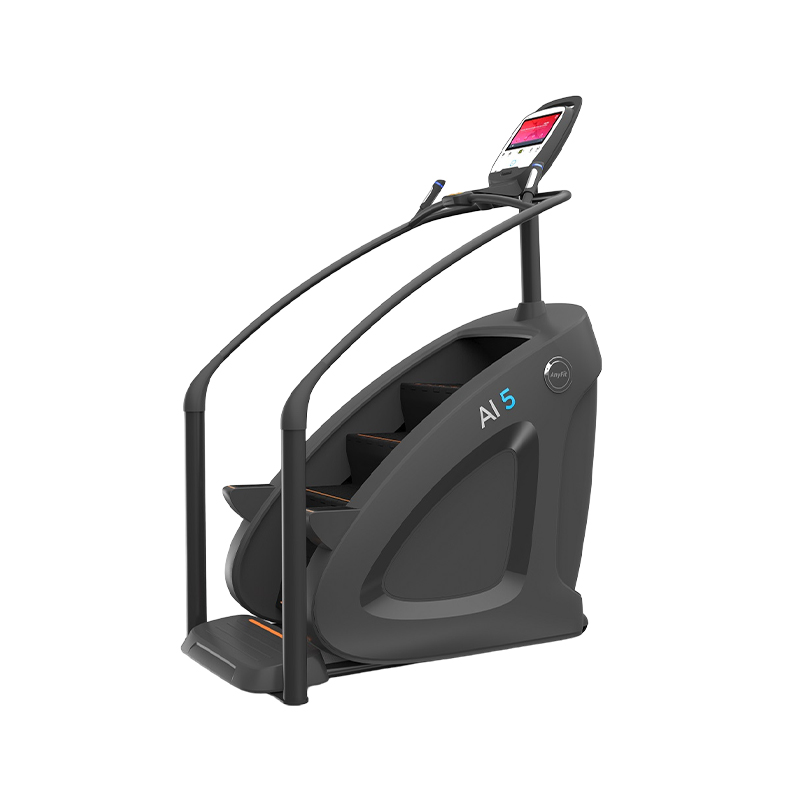
The design of aerobic stair climbers needs to deeply integrate the principles of human biomechanics. By optimizing core aspects such as movement trajectory, resistance adjustment, joint protection, and interactive feedback, a training system that conforms to the natural movement patterns of the human body can be constructed, thereby improving exercise efficiency, reducing the risk of injury, and enhancing the user experience.
When climbing vertically, the hip, knee, and ankle joints need to work together to complete extension and flexion movements, forming a continuous "push-pull" kinetic chain. The stair climber's pedal trajectory design should simulate this natural path, using an arc-shaped or spiral ascending structure to ensure that the foot remains perpendicular to the lower leg throughout the movement, avoiding knee valgus or excessive forward movement caused by traditional straight-line trajectories. This design can distribute joint pressure, evenly distributing impact force to the lower limb muscles and reducing the risk of single-point overload.
Intelligent resistance adjustment systems are key to conforming to biomechanics. Traditional stair climbers often use a fixed resistance mode, which can easily lead to muscle fatigue accumulation or insufficient training intensity. Modern designs should introduce dynamic resistance adjustment technology, using sensors to monitor the user's cadence, pedaling force, and heart rate changes in real time, automatically matching the optimal resistance value. For example, when a user accelerates, the system can fine-tune the resistance to maintain the target heart rate zone; during deceleration, it reduces resistance to prevent excessive muscle stretching. This adaptive adjustment ensures that exercise intensity remains within the aerobic metabolic dominance zone, improving fat burning efficiency.
Joint protection mechanisms need to be integrated throughout the entire design process. The knee joint, as the most vulnerable area, requires multi-dimensional protection: the pedal surface should use anti-slip textures and elastic materials to increase foot grip and cushion impact; the pedal depth should cover the entire arch of the foot to avoid undue stress on the forefoot or heel; the handrail height and angle should be adjustable so that users can naturally maintain a neutral spinal position during climbing, reducing lumbar compensation. Some high-end models are also equipped with knee tracking systems that monitor joint movement angles via cameras or pressure sensors, immediately issuing warnings and adjusting resistance when abnormal postures are detected.
Optimization of biomechanics also needs to consider energy transfer efficiency. The design of the flywheel and drivetrain system in stair climbers directly affects the smoothness of power output. Models employing magnetic or liquid resistance technology offer more linear resistance changes, avoiding the jerky feeling caused by mechanical friction and making the exercise process closer to the real stair-climbing experience. Simultaneously, the design of the pedal rebound system is crucial; appropriate rebound force assists users in completing the knee-lifting movement, reducing quadriceps fatigue from continuous contraction and extending effective training time.
The integration of interactive feedback systems further enhances the scientific nature of exercise. Built-in displays or mobile apps should be able to display key exercise data in real time, such as cadence, heart rate, calorie consumption, and muscle exertion distribution diagrams. Through visual feedback, users can adjust their exercise posture in a timely manner; for example, if they notice excessive force on one leg, they can actively correct the shift in their center of gravity. Some models also support 3D motion analysis, comparing user movements with a standard model to generate personalized improvement suggestions, helping users gradually master the correct biomechanics.
The spatial adaptability design of stair climbers also needs to consider ergonomics. The foldable structure and lightweight materials allow users to easily move them to different training scenarios, such as the living room, balcony, or gym. The optimization of step spacing and width needs to consider the needs of users of different body types, ensuring sufficient leg movement space during exercise and preventing distorted movements due to limited space.
From a long-term health perspective, the biomechanically designed stair climbers not only improve the effectiveness of individual training sessions but also reduce the risk of sports injuries, enhancing users' willingness to continue training. By scientifically distributing muscle load, optimizing joint stress, and providing personalized feedback, these devices can help users establish correct exercise patterns, transforming aerobic training from "passive adherence" to "active enjoyment," ultimately achieving the comprehensive goals of improved cardiopulmonary function, reduced body fat percentage, and enhanced lower limb strength.